
Experts believe volatility is here to stay for some time, at least till China stabilises and clarity regarding the US Fed's interest rate move emerges.

Besides, the quantum of FPI investments via P-notes dropped to 3.5 per cent during the period under review from 3.8 per cent in the preceding month.

Axis Bank was the top gainer in the Sensex pack, soaring over 13 per cent, followed by ICICI Bank, HDFC Bank, IndusInd Bank and Bajaj Finance. On the other hand, Sun Pharma, UltraTech Cement, Titan and Asian Paints were among the laggards.

Do not decide your investments based on election results.

L&T was the top gainer in the Sensex pack, rising over 3 per cent, followed by Bajaj Finance, Reliance Industries, IndusInd Bank, SBI and HDFC Bank. NSE Nifty surged 168.05 points to 14,653.05.

Ministry considering tax sops for India's first global financial centre, steps to liberalise futures and options markets.

In the case of Indian equities specifically, all eyes will now be on the next RBI monetary policy scheduled for September 29.
.jpg)
The market regulator is wielding an unprecedented level of control over how mutual funds operate, delaying new launches and dictating investment strategy, frustrated insiders in the embattled industry say.

Infosys was the top gainer in the Sensex pack, rallying around 7 per cent, followed by TCS, IndusInd Bank, ONGC, HDFC Bank and HCL Tech. On the other hand, ITC, Bajaj Finance, Kotak Bank and Sun Pharma finished in the red.
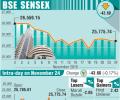
The 30 share Sensex ended at 25,776 levels, down by 44 points.

Mutual funds subscriptions and redemptions will not be permitted on February 1 because all the fund houses in their scheme information documents have declared Saturday and Sunday as "non-business day".

According to traders, recovery in global equities and hopes of growth-boosting measures in the upcoming Budget buoyed market sentiment. Further, short-covering ahead of January derivatives expiry also lifted key indices, they said.

The new norms provide an operational framework for FPIs, a new class of overseas investors that club all existing class of investors like foreign institutional investors and Qualified Foreign Investors.

Among other measures, for stocks in F&O segment meeting certain criteria, Market Wide Position Limit might be revised to 50 per cent of the existing levels.


Bars FII from issuing offshore derivative instruments on grounds of rules violation.

US auto major Ford Motor Co on Friday said it and India's Mahindra & Mahindra have decided to scrap their previously announced automotive joint venture and it will continue its independent operations in India as it is. The two companies determined that they will not complete a previously announced automotive joint venture between their respective companies. The decision follows the passing of the December 31, 2020 'longstop' or expiration date of a definitive agreement the organisations entered into in October 2019, Ford Motor Company said in a statement.

The finance minister did very well for equity market investors but not so with families, reveals Mahesh Vyas.
At close, the Sensex was up seven points at 24,556 and the Nifty gained 11 points to end the session at 7,330.

Top losers in the Sensex pack included Tata Steel, Vedanta, Maruti, SBI, Coal India, Tata Motors, Sun Pharma, HUL, RIL, IndusInd Bank, Axis Bank, HDFC duo, ICICI Bank, M&M, Kotak Bank, and Infosys, falling up to 2.89 per cent.
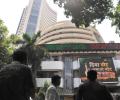
After a positive opening, the 30-share BSE Sensex suddenly faced selling pressure in late-afternoon trade. It finally settled just 5.67 points, or 0.01 per cent, lower at 39,586.41.

The 50-stock NSE barometer Nifty finished 14.75 points, or 0.14 per cent, down at 10,382.70 after shuttling between 10,340.65 and 10,393.15.

The quantum of FPI investments via P-notes remain unchanged at 6.6 per cent in March.

Portfolio investors based out of the US and other countries with which India does not have favourable tax treaties will have to pay a 15 per cent tax on their derivative transactions, after the Budget decided to classify income from all foreign portfolio investment as capital gains.
A derivative is a product whose value is derived from the value of one or more underlying variables or assets in a contractual manner. The underlying asset can be equity, forex, commodity or any other asset.

'The business continuity clause will mean the Tatas will have to keep running the airline for three years, and cannot exit the flying business.'

It is mystifying how the NSE, a near-monopoly, gets protection, as the February 24 episode shows, when it is competition and accountability that should be the regulatory objective, says Debashis Basu.

Foreign institutional investors (FIIs) will have to provide more details of their activities in Indian equity markets to the capital markets regulator from April.
Stock exchanges are said to be toying with the idea of opening a regular trading window on Saturdays. The window may be for a shorter duration, in line with the Saturday banking hours.

'It really doesn't matter that investors getting allotments sell their IPO stock holdings on listing day because a new set of investors are entering.' 'This explains the continued rise in stock prices even after the first day of listing.'
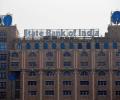
SBI chief Rajnish Kumar said the focus going forward will be on cost reduction, rationalisation and reskilling of workforce, improving staff productivity and redeployment of workforce from admin offices to sales roles.

Indian equity markets are likely to witness volatility this week due to concerns over rising cases of coronavirus and expiry of derivatives contracts, analysts said. Further, progress surrounding the COVID-19 vaccine, related updates, US stimulus talks and global cues would dictate the market trend, traders said. "Going ahead, the market is likely to be volatile as sentiments oscillate between fear of rising COVID cases globally and optimism over vaccine progress. Investors would closely watch out development over the US stimulus talks," said Siddhartha Khemka, Head - Retail Research, Motilal Oswal Financial Services Ltd.

NTPC was the top gainer in the Sensex pack, rallying 3.44 per cent. Bharti Airtel, Bajaj Finance, TCS, HDFC twins, Yes Bank and RIL too gained up to 2.33 per cent.

L&T was the top gainer in the Sensex pack, spurting over 6 per cent, followed by Hero MotoCorp, HDFC Bank, IndusInd Bank, Maruti, HDFC and HCL Tech. On the other hand, ITC, SBI and Bharti Airtel ended in the red.

The 5 per cent equity investment is the maximum equity interest permitted to foreign investors in derivative exchanges

The government has brought in changes to the investment pattern for non-government provident funds, and superannuation and gratuity funds, enabling them to invest up to 5 per cent in the units of Category I and Category II alternative investment funds (AIFs), subject to some caveats. The development is part of the central government's strategy to channelise domestic savings and improve their returns to attract more investment in the said sectors. At present, these funds typically invest a minimum 45 per cent in government securities, besides new instruments, such as exchange-traded funds and real estate investment funds, while a portion in equity-related instruments.

'The digital trust level has drastically gone up due to Covid, not only in tier-I and II cities, but also in tier-III, IV and V geographies,'
Coal India, ONGC, M&M and Tata Motors among the top losers.
 © 2026 Rediff.com - Advertise with us - Disclaimer - Privacy Policy - Sitemap - Feedback - About us - Terms of use - Grievances